Enterprise-Grade Custom AI Agent Development: Automate Workflows with Intelligent Autonomous Systems
Published on 21 November 2025
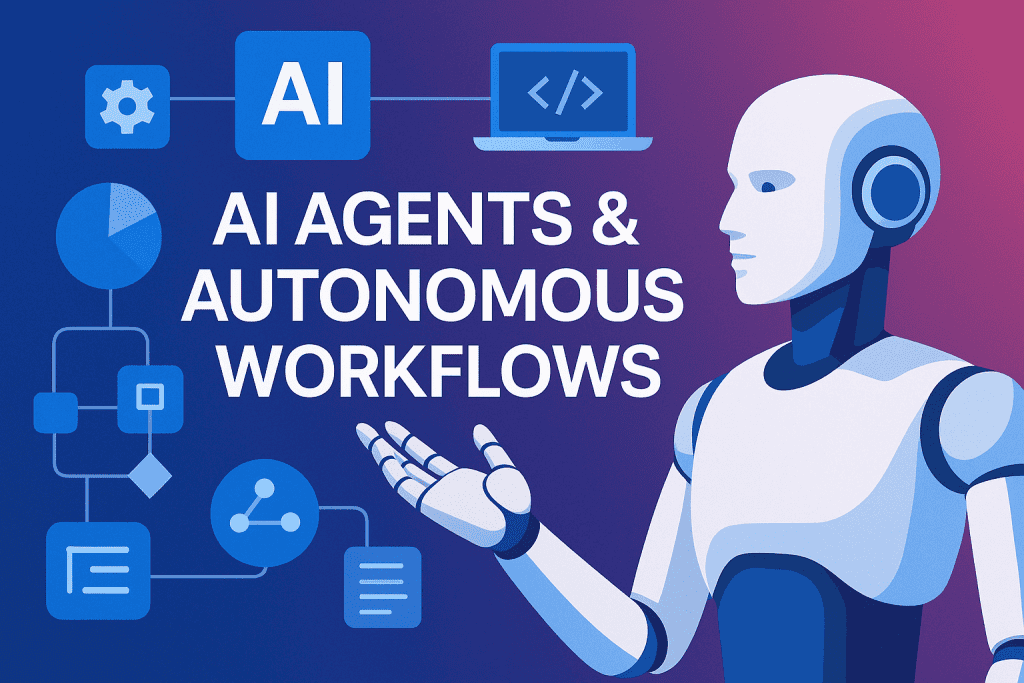



To remain competitive in a rapidly changing environment, organisations should update their operations. This blog explores how enterprise-oriented AI agent development— including custom and workflow automation agents using large language models—is advancing automation beyond traditional methods. It explains these concepts, their real-world impact, and the criteria for selecting the right AI agent development provider.
Introduction
From startups to large enterprises, organisations seek automation to enhance operational efficiency. Custom AI agent development enables intelligent systems that automate tasks, manage workflows, and deliver scalable value for enterprises.
Organisations face productivity gaps due to slow decision cycles, repeated manual work, and complicated operational systems. Businesses shift from managing work to automating it using AI-powered agent solutions and agentic AI. This blog is a guide that walks you through how to build, deploy, and grow enterprise-grade custom agentic AI, so that your teams focus on strategic work while AI agents handle the rest.
What Is Custom AI Agent Development?
Custom AI agent development refers to designing intelligent systems tailored to your organisation’s needs. These systems manage operations, data, and workflows autonomously. They outperform basic automation tools by using enterprise AI agents that take actions, make decisions, and scale across departments without human intervention.
These solutions are developed by specialists who understand both business workflows and technical architecture. When implemented correctly, they empower organisations to leverage AI workflow automation agents that accelerate processes and eliminate manual effort. Custom LLM agent development uses large language models to ensure reasoning, context-awareness, and adaptive responses.
Why Enterprises Need Custom AI Agents Today
Faster Operations Through Workflow Automation
AI workflow automation agents streamline operations previously dependent on human input, reducing daily workload and increasing speed.
Reducing Manual Work Through Cognitive AI Agents
Task automation agents and cognitive AI agents help manage routine queries, reducing pressure on employees.
Data-Driven Decisions Using LLM-Powered Intelligent Agents
Enterprises require fast and accurate decision-making. LLM-powered agents deliver this by automating analytical workflows and generating insights previously handled manually.
Enterprise Use Cases Across Industries
Each industry has unique challenges—custom agents help overcome them. AI agents now exist in finance, healthcare, retail, IT, and many other domains.
Types of AI Agents Businesses Can Build
Conversational AI Agents for Customer Support
These agents combine natural language understanding with backend data to resolve queries automatically.
Task Automation & Workflow Orchestration Agents
They synchronize data across systems and execute multi-step workflows.
Domain-Specific AI Agents
These are designed for industry-specific rules, terms, and workflows for unmatched accuracy.
Multi-Agent Systems
Multiple agents collaborate, delegate tasks, and operate as a unified automation system.
Core Components of a Custom AI Agent
LLM Architecture
Fine-tuned LLMs provide reasoning, context-awareness, and natural language interaction.
Memory, Learning & Context Retention
These make agents proactive and adaptive, reducing repeated user prompts.
Multi-Agent Orchestration Layers
AI orchestration engines coordinate agent interactions and ensure seamless workflow execution.
How to Build a Custom AI Agent (Step-by-Step)
Process Mapping & Analysis
Map workflows, define KPIs, and identify automation opportunities.
Choosing the Right LLM & Architecture
Compare OpenAI, Anthropic, Llama, and Mixtral based on your enterprise needs.
Developing Autonomous Behaviors
Embed logic, triggers, and decision-making rules for autonomy.
Integrating APIs & Internal Systems
Build connectors for CRM, ERP, HRMS, and databases following intelligent agent development principles.
Industry Use Cases
- Customer Support: Automates triage, routing, and responses.
- Finance: Handles risk analysis, compliance, and reporting.
- Healthcare: Supports clinical workflows.
- Retail: Manages orders and inventory.
- IT Ops: Automates QA, monitoring, and incident resolution.
- HR: Streamlines screening, onboarding, and documentation.
Conclusion
By adopting custom AI development, enterprise AI agents, and multi-agent systems, organisations can transform operations and unlock long-term scalability. Deploying autonomous agents, custom LLM agents, and domain-specific AI solutions allows businesses to automate workflows, enhance decision-making, and accelerate growth.
Read more blogs
Blueprint of Business AI Transformation 2026
From Code to No-Code: How Low-Code Platforms Are Changing Enterprise App Development